

Yes, a general dentist can remove a broken tooth when a filling, crown, or root canal cannot repair it. Can a dentist pull a broken tooth at the gum line? Usually yes, with a surgical extraction. The area is numbed first, so you should feel pressure but not sharp pain.
Key Takeaways
- Saving a natural tooth is usually the first goal, so removal is often the last option.
- A tooth that crumbles during removal may need surgical steps.
- Avoid straws, smoking, and hard spitting for the first days to protect the blood clot.
- Plan the replacement before the tooth comes out, because an open gap can let nearby teeth drift.
- Omni Dental sees dental emergencies Monday to Friday, 10 AM to 6 PM.
Estimated read: 8 min
When Can a Broken Tooth Be Saved?
Saving a natural tooth is usually the first goal, because it protects your bite and oral health. So a dentist looks for a way to repair the tooth before talking about removal. That is true even when the break looks bad in the mirror.
On our emergency dentist page, Dr. Poles lists three common ways to treat a damaged tooth:
- A filling to repair the damaged part of the tooth.
- Covering what is left with a new crown.
- A root canal for a damaged or infected tooth.
Which option fits depends on how much of the tooth is left and what the X-ray shows. An X-ray shows the roots and bone, which no mirror can show you. That is why the choice is made at the exam, not over the phone.

When Does a Broken Tooth Need to Come Out?
Removal is often the last option, but sometimes it is the right one. Our tooth extraction page lists the main reasons a tooth may need to come out:
- The decay or fracture is too severe for a filling, crown, or root canal.
- An infection has spread and cannot be cleared while keeping the tooth.
- Gum disease has loosened the tooth because the bone around it is gone.
The Cleveland Clinic guide to tooth extraction also lists a fractured tooth and dental trauma as common reasons. It adds that extraction is considered when damage is past the point of repair. In other words, a crack alone does not mean the tooth must go.
Before anything is done, Dr. Poles explains why he recommends removal and what else could work, and then you decide together. Sometimes saving the tooth with a root canal is a real option.
Can a Dentist Pull a Broken Tooth Below the Gum Line?
Yes, a dentist can usually remove a tooth that broke at or below the gum line. Because the tooth cannot be lifted out in one piece, it typically needs a surgical extraction. For that, the dentist makes a small opening in the gum and sometimes removes the tooth in sections.
A whole tooth that sits fully above the gum is different. It usually comes out with a simple extraction, where the tooth is loosened and lifted out. The table below compares the two types, based on our extraction page.
| Detail | Simple extraction | Surgical extraction |
|---|---|---|
| Used for | Teeth fully visible above the gum | Broken, impacted, or partly erupted teeth |
| How it is done | The tooth is loosened and lifted out | A small opening in the gum, sometimes in sections |
| Stitches | Not always needed | Often placed to help the gum heal |
| Healing | Usually quicker | Can take a little longer, with more swelling at first |
A badly decayed or broken tooth may also crumble during removal. In that case, a simple extraction can need surgical steps, so ask which type your tooth needs. General dentists do many extractions, while Cleveland Clinic notes that complex cases are usually referred to specialists.
Dr. Poles tells you if your case is one of those, and why.
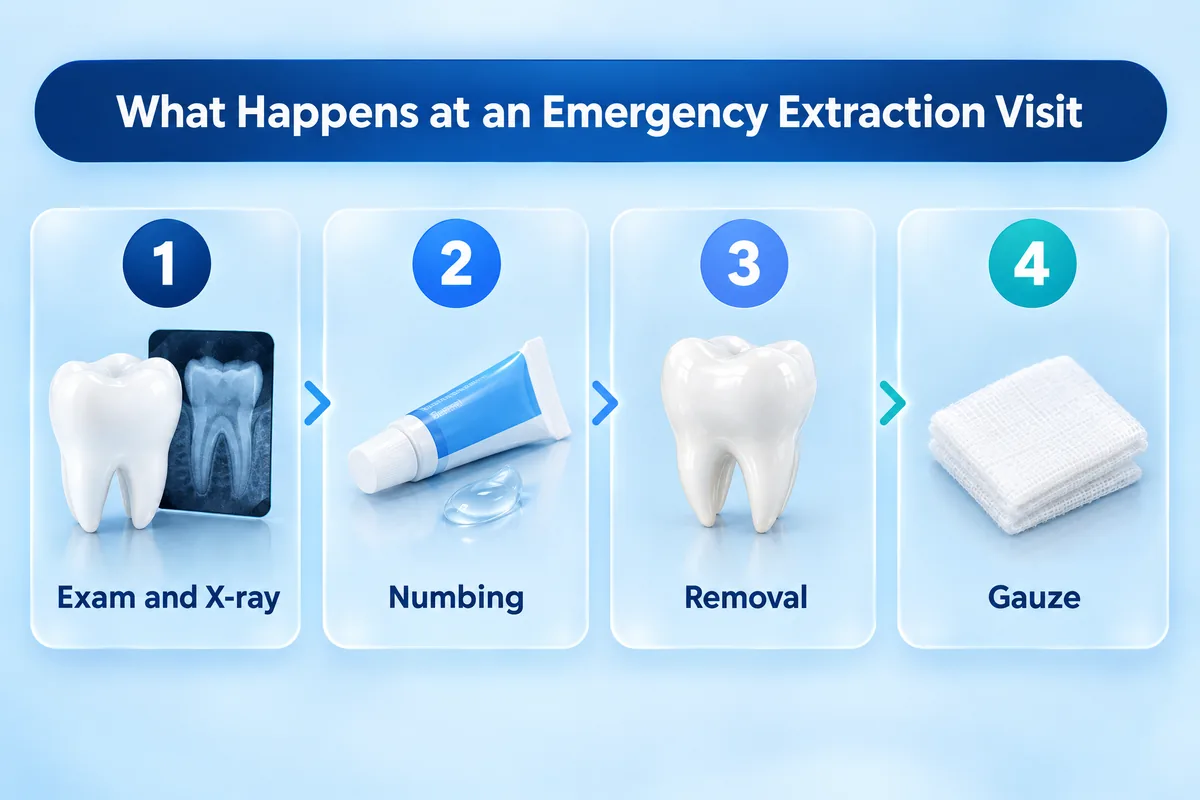
What Happens at an Emergency Extraction Visit?
At an emergency visit, Dr. Poles focuses on two things first: easing your pain and finding the cause. Before the exam, we ask when the problem started, what makes it worse, and about your health and medicines.
If the tooth cannot be saved, the visit usually follows these steps:
- Exam and X-ray: the X-ray shows the roots and the bone around them.
- Numbing: the area is fully numbed before any work starts.
- Removal: the tooth comes out with a simple or surgical extraction.
- Gauze: you bite on gauze so a blood clot forms in the socket.
During removal, you feel pressure but should not feel sharp pain. If you do, tell us right away, and more numbing can be given. Cleveland Clinic says removing one tooth usually takes 30 to 60 minutes.
Most extractions are finished in a single visit. The blood clot matters, because it protects the bone while it heals.
What Should You Do Before Your Visit?
Home first aid is simple, and it keeps you more comfortable until the exam. The ADA's dental emergencies guide gives these steps for a cracked tooth:
- Rinse your mouth with warm water right away.
- Apply a cold compress to your face to limit swelling.
- See a dentist as soon as possible.
How long can a broken tooth wait? Our emergency page rates a broken tooth with pain or a sharp edge as urgent. Some problems can wait a day or two with simple home care, but early care often limits damage to the tooth.
Our emergency page adds one more tip: save any broken pieces of the tooth. Also, never put a pain pill against the gum, because it can burn the tissue. Instead, ask your doctor or pharmacist which pain reliever is safe for you.
Swelling that affects breathing or swallowing, or heavy bleeding, is a medical emergency. In that case, call 911 or go to an emergency room now. For a broken tooth without those signs, call (847) 483-8833 during office hours, Monday to Friday, 10 AM to 6 PM.

How Do You Heal After a Broken Tooth Extraction?
Healing starts with the blood clot in the socket. For the first days, avoid hard spitting, straws, smoking, and forceful rinsing. Smoking and straws can dislodge the clot and lead to a dry socket.
These general tips from our extraction page also help the socket heal:
- Keep the gauze in place with gentle pressure for the time we advise.
- Eat soft foods and chew on the other side at first.
- Use a cold pack on the cheek in short sessions during the first day.
- Brush the other teeth gently and rinse as instructed.
For soft foods, Cleveland Clinic suggests rice, pasta, eggs, yogurt, and applesauce. It also says most people return to routine activities within 48 to 72 hours. Still, follow the aftercare instructions you get for your own case.
Call the office if pain gets worse after a few days, or if bleeding will not stop with pressure. A fever or growing swelling is another reason to call. Cleveland Clinic names a fever of 100.4 F or higher and pus or drainage as warning signs.
What Fills the Gap, and What Does It Cost?
A gap from a back tooth can let nearby teeth tip or drift, and the bone there can shrink over time. So it helps to plan the replacement before the tooth comes out. Common options include a dental implant, a bridge, or a denture.
Placing an implant right after removal can mean fewer surgeries overall. However, it is not right for every tooth, because bone health, infection, and tooth position all matter. Dr. Poles decides at your exam whether it fits your case.
Cost works the same way, since the price depends on the tooth and the work it needs. The table below shows the main factors from our tooth extraction cost guide.
| Cost factor | What changes the price |
|---|---|
| Simple or surgical | Broken teeth often need surgical steps, which usually cost more |
| Which tooth | Molars have two or three roots; front teeth usually one |
| Number of teeth | Each tooth is usually priced on its own |
| Exam and X-rays | Diagnosis and imaging are part of the cost |
| Replacement | An implant, bridge, or denture is a separate treatment |
Most dental plans include extractions, but the details vary by plan. We accept most major plans, including Aetna, BlueCross BlueShield, Cigna, Delta Dental, and MetLife. You can also ask for a written estimate of the whole cost up front.
Broken a tooth today? Contact Omni Dental to ask how soon you can be seen.
Frequently Asked Questions
Can the ER fix a broken tooth?
Most hospital emergency rooms have no dentist on duty, so they usually cannot fill, repair, or save the tooth. An ER can treat a spreading infection, control bleeding, and manage a serious injury. Afterward, bring any ER paperwork or X-rays to your dental visit.
Do I need to be a current patient to come in?
No, you do not need to be a current patient to call. New patients with urgent problems can phone (847) 483-8833, and we ask a few questions to judge how urgent it is. Bring your ID, your insurance card if you have one, and a list of your medicines.
What if a tooth breaks at night or on a weekend?
Omni Dental is closed nights and weekends. For pain without breathing trouble, heavy bleeding, or a serious face injury, use the first aid steps above. Then call at 10 AM on the next weekday and say when the pain started.
How long does soreness last after the tooth is pulled?
Cleveland Clinic says discomfort is usually worst on day three, and side effects should go away within a week. The jawbone takes several weeks to heal. For a molar, the jaw may take up to four months to heal, so keep following your aftercare plan.
How do I stop bleeding before or after the visit?
Press clean, damp gauze on the area for 10 to 15 minutes. After an extraction, Cleveland Clinic says bleeding may ooze the first night. Fold fresh gauze, bite down for 15 minutes, and call the office if bleeding will not stop with pressure.
Help for a Broken Tooth in Arlington Heights
If you are asking can a dentist pull a broken tooth, Dr. Poles can tell you at an exam whether it can be saved first. Call (847) 483-8833 to book.

About the author
Dr. Bilus D PolesDDS,MAGD,DICOI, DIDIA
Founder and lead dentist of Omni Dental of Arlington Heights. Master of the Academy of General Dentistry and Board Certified Diplomate of the ICOI and IDIA. Illinois license #019.027365.